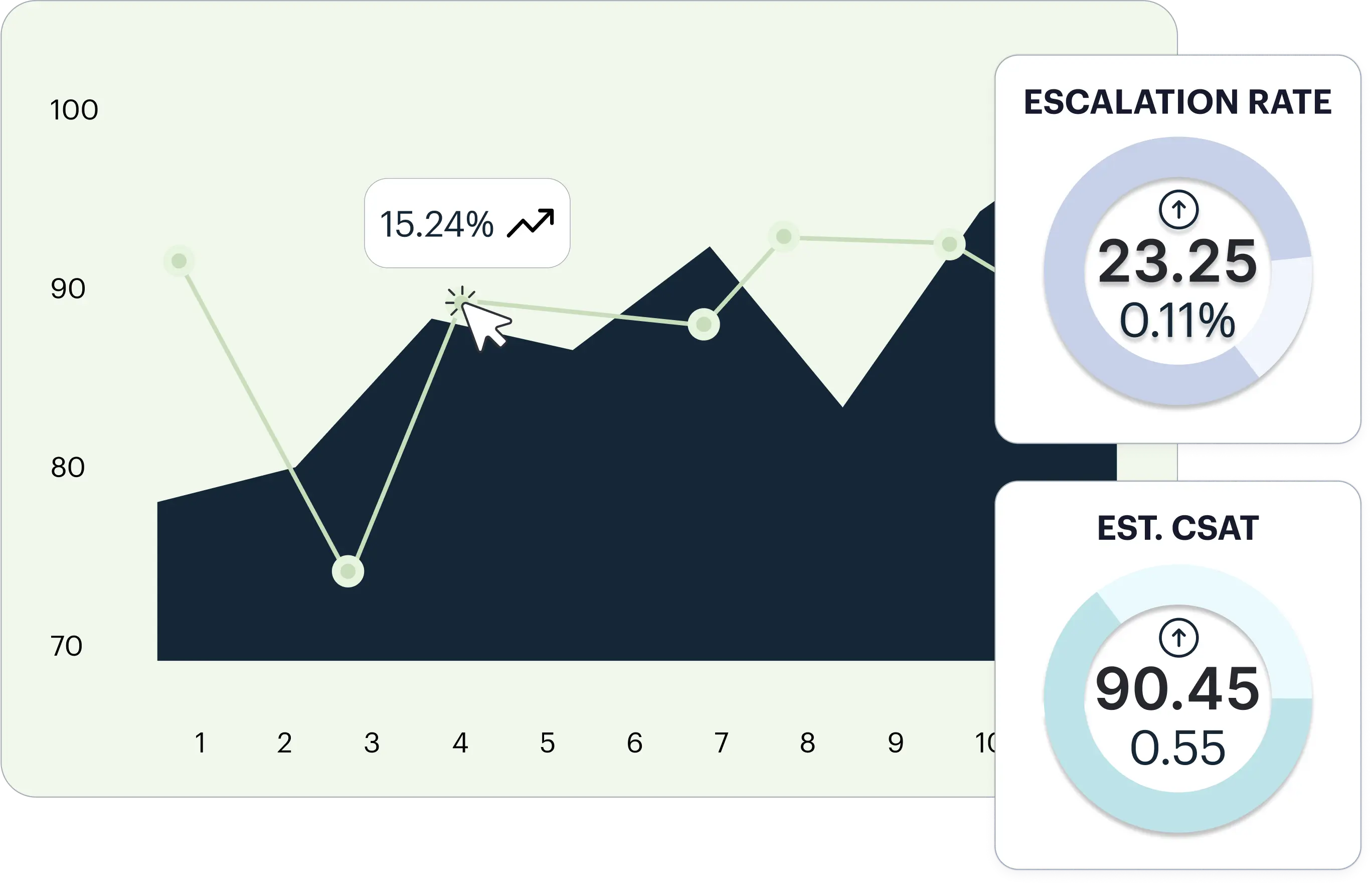
This scenario plays out every quarter. A CX leader presents their quarterly report, pointing to an 85% customer satisfaction score from their latest survey. Meanwhile, the Head of Support flags a troubling rise in churn and escalations. The disconnect is palpable. Two weeks later, a competitor launches a campaign targeting exactly the pain points buried in those unanalyzed support conversations. The CX leader never saw it coming. The problem isn't the survey data; it's that surveys reflect only a sliver of the customer voice. The real story, the complete customer truth, is hidden inside 99% of conversations happening every day across support calls, chats, and emails.
This gap between perception and reality is where businesses either win or lose. Relying on lagging indicators from a tiny, self-selecting group of customers doesn't just miss the target. It opens the door for competitors to steal your edge. An Aberdeen benchmark study, conducted over eight months across 200 North American contact centers, showed that those using conversation analytics software saw a 76% first contact resolution rate, more than three times better than the 23% rate of those without it. The data proves it: knowing what customers actually experience, not just what a few report in surveys, is now a non-negotiable competitive advantage. Move beyond sampling, embrace full conversation intelligence.

What Is Conversation Analytics?
Conversation analytics is an AI-driven analysis of unstructured customer conversations from every touchpoint. Think of it as a strategic intelligence layer that turns every single interaction (phone calls, support tickets, chats, and emails) into structured, actionable data. It shifts your perspective from what happened to why it happened, and what's likely to happen next.
This isn't another dashboard. It's predictive intelligence that transforms your contact center from a cost center into a powerhouse for customer and business growth. Without it, you're flying blind, making critical business decisions based on incomplete data while competitors who listen to 100% of customer conversations pull ahead. With robust conversation analytics software, you unlock what we call Voice of the Customer 2.0.
Let's make the comparison clear:
Traditional VoC (1.0):
Relies on surveys that reach just 3–7% of customers
Looks backward, asking about past experiences
Gathers self-reported feedback (what customers remember or choose to share)
Lagging indicator (by the time issues appear in surveys, the damage is done)
Quarterly or monthly cadence
Voice of the Customer 2.0:
Analyzes 100% of customer interactions across channels
Captures genuine experiences as they happen (concurrent, real-time)
Relies on behavioral data (what customers actually say and do when needing help)
Leading indicator (detects and resolves problems as they emerge)
Always-on, continuous intelligence
VoC 1.0 asks customers to grade their experience. VoC 2.0 listens to the unfiltered reality of that experience as it unfolds. Ignore this evolution, and you operate with massive blind spots, making high-stakes decisions on incomplete information. Organizations that tune in to the true voice of their customer gain an unbeatable edge.

Why Conversation Analytics Matters for CX Leaders
As a CX leader, your success is measured by clear KPIs: Net Promoter Score (NPS), Customer Satisfaction (CSAT), and Customer Effort Score (CES). But your real challenge isn't just moving these numbers—it's proving that customer experience drives measurable business impact across the entire organization. Conversation analytics software transforms every customer interaction into intelligence that doesn't just measure satisfaction, but actively drives improvements across product, support, and strategic decision-making.
Let's ground this with an everyday example: Your quarterly survey goes out to 200 customers and gets a 15% response rate. Meanwhile, your support team handles 47,000 conversations in the same quarter, each containing insights about the customer journey, pain points, and product opportunities. Which dataset would you trust for business strategy?
Net Promoter Score (NPS): NPS is more than just a number—it's the reasons behind it that matter, and who needs to act on those reasons. Kapiche's AI enrichment layer analyzes 100% of customer conversations and estimates satisfaction scores for every interaction, revealing the real stories behind promoter, passive, and detractor segments. But here's what makes it strategic: when Kapiche identifies that mobile banking login friction is suppressing NPS by 8 points, that insight doesn't just sit in a CX report. It flows directly to your product team with specific examples, frequency data, and impact metrics they need to prioritize the fix. Instead of waiting for quarterly survey results from 3-5% of customers, you're delivering product intelligence your engineering team can actually act on.
Customer Satisfaction (CSAT): Traditional CSAT surveys reach fewer than 7% of your customers and measure perception, not actual experience. Kapiche's intelligence layer transforms every support conversation into a satisfaction signal by analyzing conversation patterns, resolution outcomes, and customer sentiment in real-time. When Telstra implemented Kapiche's estimated CSAT scoring across 100% of their interactions, they surfaced a satisfaction drop caused by a policy change within hours—and immediately routed that intelligence to the teams who could fix it. Your support leaders get visibility into which issues are degrading experience, your product team sees which features are causing confusion, and your training team identifies knowledge gaps—all from the same conversation data.
Customer Effort Score (CES): High effort is a top cause of disloyalty, and traditional measurement only captures it after customers have already struggled. Kapiche's cross-channel intelligence pinpoints exactly where effort spikes across the journey by analyzing conversation themes, resolution times, and escalation patterns. But it goes further: when customers say "I couldn't find how to cancel," that becomes a specific insight for your digital experience team. When chat transcripts show repeated failed authentication attempts, that's a technical issue for the product. When agents transfer customers multiple times, that's a process improvement for your support operations team. Each insight reaches the team that can actually solve it.
From measurement to activation: How insights reach the teams who need them
This is where Kapiche fundamentally differs from traditional analytics. We don't just help you understand what's happening—we structure insights, so they're immediately actionable for the teams who can fix the problems:
For your Product team: Kapiche's unified conversation analysis consolidates every product mention across support calls, chat, email, and tickets into a single intelligence feed. When 23% of cart abandonment conversations mention iOS payment selector frustration, your product manager doesn't need to dig through raw transcripts—they get a Product Feedback Report showing exactly what customers are struggling with, how often it's happening, and the estimated impact on satisfaction. Shopify used this exact capability to prioritize their mobile checkout redesign based on real usage patterns, not survey speculation.
For your Support organization: Your Head of Support and their team leaders get AI-powered Agent QA Summary Reports analyzing every single conversation—not the traditional 1-5% sample. Support leaders can finally answer "Are we consistently delivering great experiences?" with 100% visibility. When Kapiche identifies that top performers use specific empathy phrases, that becomes immediate coaching intelligence for team leaders. When conversation themes spike outside normal ranges, managers get real-time alerts to prevent small issues from becoming crises.
For your Executive team: The board doesn't care about your CSAT methodology—they care whether customer experience drives revenue protection and competitive advantage. Kapiche's Executive Trend Briefings transform raw conversation data into strategic intelligence: "Mobile login friction cost us $307K in predicted churn this quarter" is a number your CFO understands. When you can prove that each NPS point drives measurable business impact, CX stops being "feel-good fluff" and becomes a strategic revenue driver.
The Hidden Cost of Survey-Only Strategies
If your support team handles 5,000 conversations monthly and your survey garners just 150 responses, you're not just measuring 3% of customer experience—you're failing to activate insights across your entire organization.
Financial Impact: A product bug affecting 8% of customers may not appear significantly in your CSAT or NPS responses for months. By then, the retention hit has already landed, and your product team has wasted cycles on features that don't address real customer pain.
Opportunity Cost: Every day without conversation analytics means product opportunities buried in "How do I expand my plan…" conversations never reach your product team, friction points creating support volume ("struggling to upload photos on Android") don't trigger digital experience improvements, and competitive threats ("I'm thinking of switching to [Competitor]") sit undetected instead of flowing to your retention team.
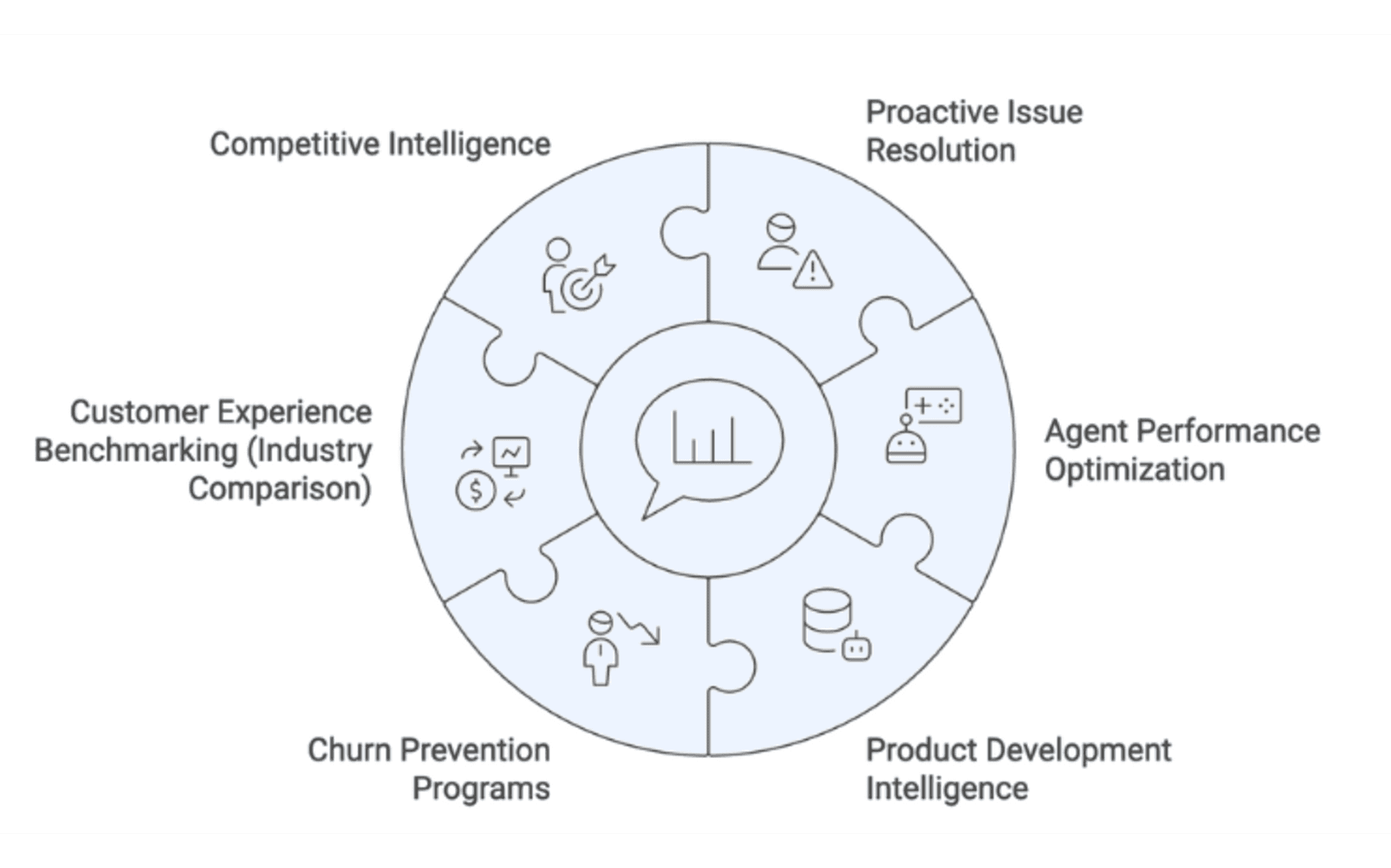
How to Use Conversation Analytics: 6 Strategic Applications
Deploying conversation analytics software isn't about adding another tool. It's about transforming how your business operates across every KPI that matters.
1. Proactive Issue Resolution (Real-time Intelligence)
Top teams prevent problems before they spread. In June, Atlassian detected a spike in "login timeout" mentions across 847 support tickets in just four hours. Instead of waiting for angry tweets, the product team deployed a backend fix before the issue hit social media, eliminating unnecessary churn and negative press. Kapiche's auto-theme detection arms you with this same superpower, transforming firefighting into quiet, proactive control.
2. Agent Performance Optimization (100% QA Coverage)
Traditional QA samples just 1–5% of calls, missing the majority of quality or compliance issues. Kapiche's conversation intelligence means analyzing 100% of agent-customer interactions. Telstra used this approach to uncover that their highest-performing agents consistently used empathy phrases like "Let me check that for you right away," and coaching others to do the same reduced average handle time by 18% across the team, delivering faster, friendlier support at scale.
3. Product development intelligence (Cross-channel insights)
Customers tell you exactly what to build in every conversation, but if product teams only see escalated tickets or quarterly survey themes, they're designing with massive blind spots. Kapiche's unified conversation analysis transforms every channel (support calls, chat, email, tickets, even reviews) into a single product intelligence feed.
How it works in practice: Shopify's product team was debating mobile checkout priorities when Kapiche revealed that 23% of all cart abandonment conversations across every channel referenced frustration with the payment selector on iOS specifically. Not "mobile checkout generally"—the specific iOS payment flow. That level of precision, backed by volume data showing it was a systemic issue not an outlier, moved the mobile checkout redesign to the top of their roadmap.
What your product team gets: Instead of product managers manually reviewing Zendesk tickets, they receive structured Product Feedback Reports showing:
Feature requests ranked by frequency and estimated satisfaction impact
Bug reports with severity based on actual customer frustration signals
Competitive intelligence showing which competitor features customers mention most
Usage friction points with specific examples from real conversations