Text mining has emerged as a crucial tool for insights professionals. With the increasing amount of text feedback data from customers, social media, and various other sources, the ability to effectively analyze this unstructured data has become vital for businesses.
Text mining allows companies to extract meaningful patterns and insights from large volumes of textual data, helping them make informed decisions and improve their customer experience.
Many teams struggle with the challenges of managing so much data, particularly getting to meaningful interpretations of it all.
In this article, we'll provide a comprehensive look at what text mining is, how it helps, and some ways to apply it to your work. You'll get a better understanding of how text mining can transform your approach to customer feedback, and how tools like Kapiche can streamline the process.
Let's dive in!
What is Text Mining?
Text mining, also known as text data mining or textual data mining, is the process of extracting meaningful information and insights from unstructured text data. This involves various techniques and tools to analyze and interpret textual data, transforming it into a structured format that can be easily understood and utilized.
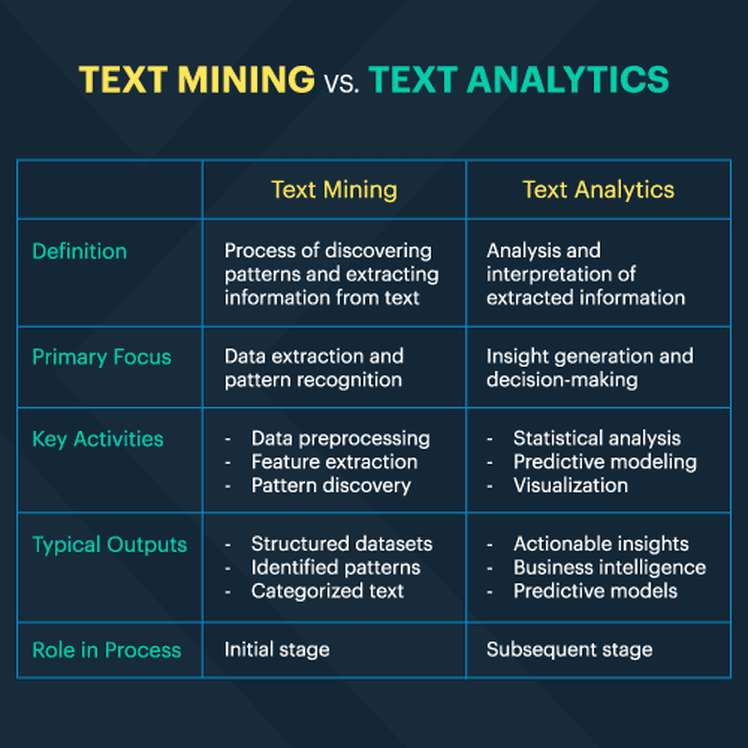
Text Mining vs. Text Analytics
While text mining and text analytics are often used interchangeably, they refer to different processes. Text mining focuses on discovering patterns and extracting information from text, whereas text analytics involves analyzing and interpreting this information to make data-driven decisions. In other words, text mining is the process, and text analytics is the outcome.
Getting Started with Text Mining
Understanding the Basics
Before diving into how text mining works, it's important to grasp the fundamentals. Here are a few key concepts to get you started:
Unstructured Data: Unlike structured data, which is neatly organized in databases, unstructured data includes text from emails, social media posts, customer reviews, and more. This data requires special techniques to analyze.
Natural Language Processing (NLP): NLP is a field of artificial intelligence that focuses on the interaction between computers and human language. It plays a crucial role in text mining by enabling machines to understand, interpret, and generate human language.
Machine Learning: Machine learning algorithms are used to identify patterns and relationships in text data. These algorithms can automatically improve their performance with more data, making them essential for effective text mining.

Real World Examples and Applications
Text mining shines in various real-world applications across different industries. Here are a few examples showcasing how it can help:
1. Customer Feedback Analysis in Retail
Imagine you're the Head of Insights at a large retail company. You've collected thousands of customer reviews, survey responses, and social media mentions. Manually analyzing this volume of data is impractical, if not impossible. Text mining can automatically identify themes, sentiments, and trends within this feedback, providing you with actionable insights. For example, you might discover that a significant number of customers are unhappy with the return policy. This insight can drive changes to improve customer satisfaction and loyalty.
2. Healthcare Data Analysis
In the healthcare industry, text mining can be used to analyze patient records, clinical notes, and medical literature. This helps in identifying patterns related to diseases, treatment outcomes, and patient experiences. For instance, analyzing electronic health records (EHRs) can reveal common side effects of a medication that weren't previously documented, leading to better patient care and safety.
3. Financial Services and Risk Management
Financial institutions use text mining to analyze news articles, financial reports, and social media to assess market sentiment and detect potential risks. For example, by mining text data from various sources, a bank can identify emerging threats such as cybersecurity risks or shifts in market conditions, enabling proactive risk management.
4. Market Research and Competitive Analysis
Companies leverage text mining to monitor competitors and understand market trends. By analyzing news, blogs, and social media, businesses can gain insights into competitors' strategies, customer preferences, and emerging market opportunities. This information is invaluable for developing competitive strategies and staying ahead in the market.
5. Legal Document Analysis
In the legal field, text mining can be used to analyze large volumes of legal documents, case law, and contracts. This helps in identifying relevant information, spotting patterns, and making informed legal decisions. For example, law firms can use text mining to quickly find precedents and extract key information from lengthy legal texts.
Text Mining Methods and Techniques
Here are the top 5 text mining methods, along with tips on how to implement them:
Method 1: Sentiment Analysis
Definition: Sentiment analysis involves determining the sentiment expressed in a piece of text, whether it's positive, negative, or neutral. This is crucial for understanding customer opinions and emotions.
How to Do It:
Collect Text Data: Gather text from various sources like reviews, social media, and surveys.
Preprocess Data: Clean the text data by removing stop words, punctuation, and other irrelevant information.
Use NLP Tools: Utilize natural language processing tools to analyze the sentiment of each text segment.
Visualize Results: Create visualizations to display the overall sentiment trends.
Example: Analyzing customer reviews for a product to understand if the sentiment is generally positive or negative, helping in product improvement decisions.
Method 2: Entity Recognition
Definition: Entity recognition involves identifying and classifying key entities in text, such as names, dates, locations, and organizations. This is useful for extracting specific information from large text datasets.
How to Do It:
Identify Entities: Use NLP algorithms to detect entities within the text.
Classify Entities: Categorize the identified entities into predefined classes.
Analyze Context: Consider the context in which entities appear to extract meaningful insights.
Example: Extracting the names of mentioned products, locations, and companies from news articles to analyze market trends.

Method 3: Topic Modeling
Definition: Topic modeling is a technique used to discover the underlying themes or topics within a collection of texts. This helps in understanding the main subjects discussed in large datasets.
How to Do It:
Prepare Data: Collect and preprocess text data.
Choose an Algorithm: Use algorithms like Latent Dirichlet Allocation (LDA) to identify topics.
Analyze Topics: Review the generated topics and their associated keywords.
Label Topics: Assign meaningful labels to each topic based on the keywords.
Example: Analyzing a collection of customer service transcripts to identify common topics like billing issues, technical support, and product inquiries.

Method 4: Text Classification
Definition: Text classification involves assigning predefined categories to text based on its content. This is useful for organizing and sorting large volumes of text data.
How to Do It:
Define Categories: Determine the categories you want to classify text into.
Train a Model: Use machine learning algorithms to train a model on labeled data.
Classify Text: Apply the trained model to new text data to classify it into the predefined categories.
Example: Classifying customer feedback into categories such as product complaints, service praise, and feature requests.
Method 5: Clustering
Definition: Clustering groups similar pieces of text together based on their content. This helps in identifying patterns and similarities within large text datasets.
How to Do It:
Preprocess Text: Clean and preprocess the text data.
Select a Clustering Algorithm: Use algorithms like K-means or hierarchical clustering to group similar texts.
Analyze Clusters: Review the clusters to understand the common themes or patterns.