You review CSAT scores every month. You analyze NPS surveys every quarter. And you're still making million-dollar decisions based on guesswork.
Here's why: Your surveys capture feedback from 7-15% of customers. Your QA team samples 1-5% of support calls. The other 95% of customer truth, the unfiltered feedback happening in thousands of daily conversations, is locked in transcripts nobody has time to read.
Every day, your teams handle hundreds or thousands of customer conversations across calls, chats, and emails. These interactions contain the raw truth about your customer experience. They tell you exactly why customers churn, what drives frustration, and where revenue opportunities are hiding. But right now, that intelligence is sitting in recordings and transcripts that no one analyzes.
Here's what that means: While you wait 30 days for your next survey results, you're hemorrhaging customers who told your support team exactly why they're leaving. You're missing product issues that are spreading. You're overlooking upsell signals that could feed millions to your sales pipeline. You just didn't have anyone, or anything, listening at scale.
This isn't just inefficient. It's a strategic risk that's getting more dangerous every quarter.
The market knows it. Gartner predicts that by 2025, 60% of customer service organizations will use conversational AI to improve agent performance and retention outcomes, up from less than 20% in 2022. Translation: Two-thirds of your competitors will soon be analyzing 100% of customer conversations while you're still waiting on survey responses.
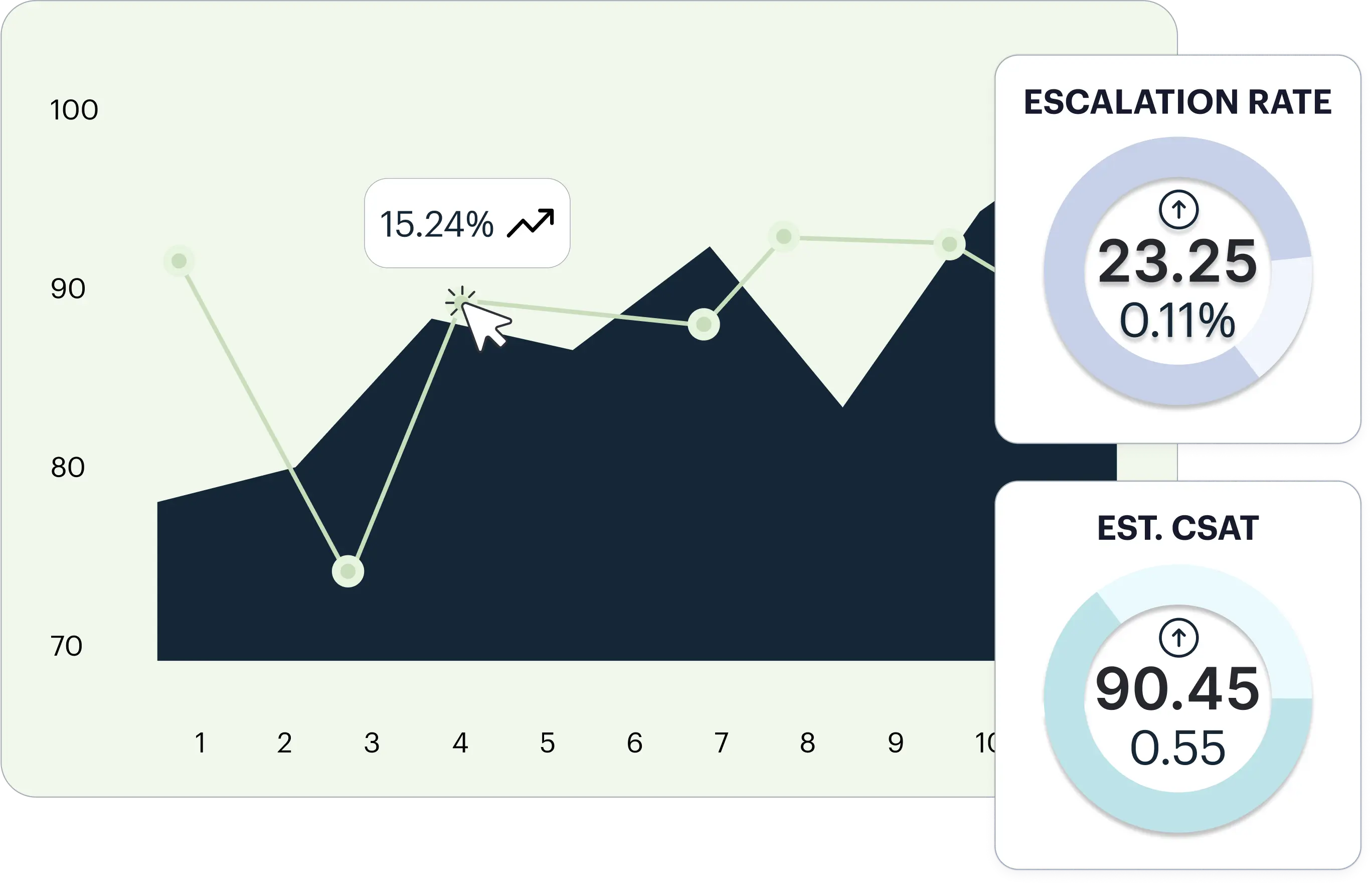
But here's what's changed: The technology to analyze every conversation, all of them, in real time, across every channel, exists now. Companies using conversation intelligence report 23% higher customer satisfaction scores and 15% lower churn compared to those stuck in the survey-only world. They've moved from Voice of Customer 1.0 (analyzing 5% of feedback through surveys) to Voice of Customer 2.0 (analyzing 100% of conversations).
This is the difference between looking in the rearview mirror and seeing the road ahead.
What Is Conversation Intelligence?
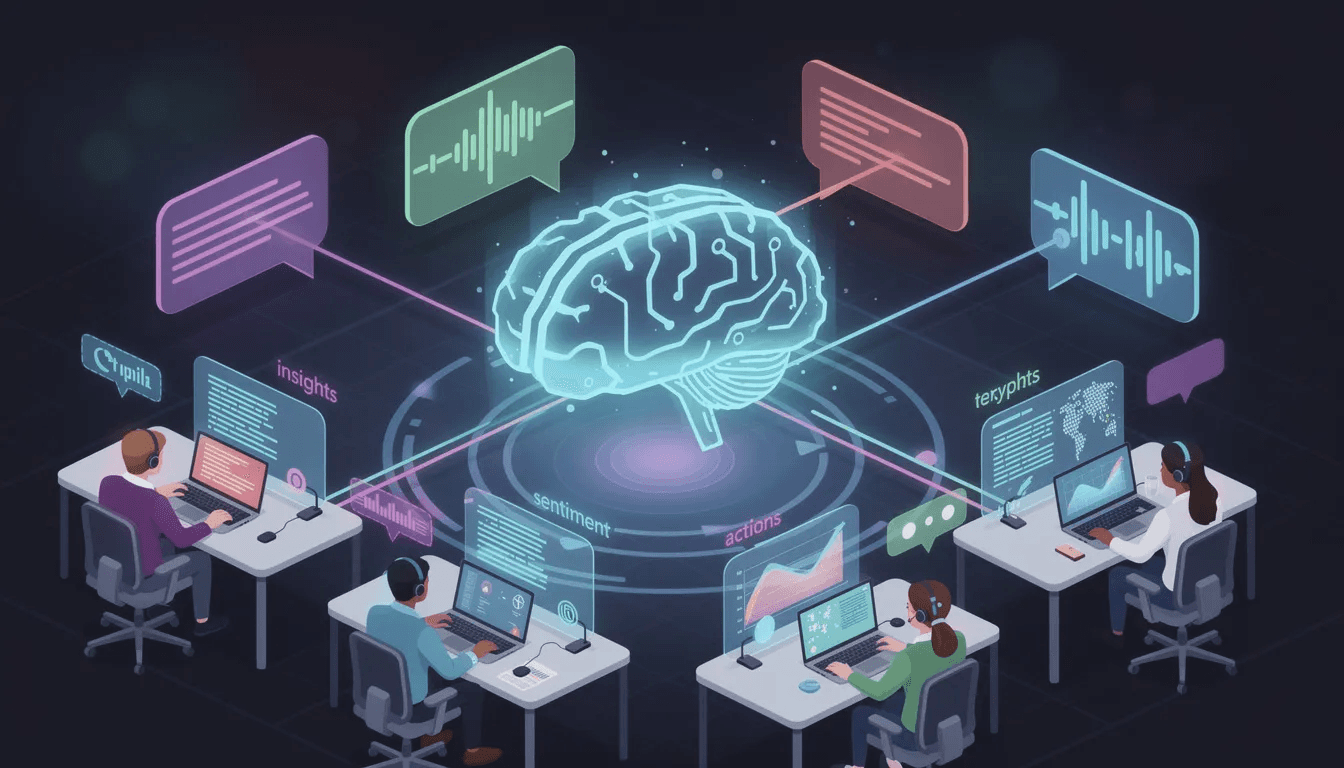
Conversation intelligence is AI technology that captures, transcribes, and analyzes 100% of your customer interactions across every channel, phone calls, chat, email, social media, messaging apps. Think of it as your business's central nervous system for customer intelligence.
Unlike traditional VoC programs that rely on surveys with 7-15% response rates (meaning 85-93% of customer sentiment goes unheard), conversation intelligence software analyzes every single interaction. This is its defining advantage: complete visibility instead of educated guessing.
The business impact shows up immediately:
You spot issues before they spread. Research shows that reducing churn by just 5% can increase profits by 25-95%. Early churn detection through conversational AI is one of the highest-ROI applications of the technology.
You make data-driven decisions instead of gut calls. Every coaching session, product decision, and support strategy is backed by comprehensive customer insights, not anecdotal feedback from the loudest voices.
You identify revenue opportunities automatically. Upsell signals, product feedback, and competitive intelligence surface from conversations without anyone manually combing through transcripts.
Without it, you're operating with massive blind spots between survey cycles. You miss early warning signs of churn. You react to problems instead of preventing them. And your strategy is vulnerable to guesswork because you're only hearing from the 7-15% of customers who bother to respond to surveys.
Why VoC 2.0 Matters Now
For 20 years, CX leaders made strategic decisions based on surveys that captured 5% of customer reality. We called this "listening to customers." It wasn't. It was listening to a small sample of customers who had strong enough opinions to fill out a form.
AI changed the game. Now you can analyze 100% of what customers actually say, not what they remember saying when you survey them three weeks later. This is Voice of Customer 2.0. And companies that adopt it are pulling ahead fast.

Why Conversation Intelligence Matters for CX Leaders
Your success is measured by clear business outcomes: revenue growth, customer retention, satisfaction scores, and operational efficiency. Conversation intelligence directly impacts every one of these KPIs by turning customer conversations into a revenue-driving, churn-reducing intelligence engine.
Improve Customer Lifetime Value
Your support team is sitting on a goldmine of upsell signals, and missing them.
Here's what's happening: A customer mentions they're struggling to integrate with Salesforce. Your agent solves the ticket and moves on. But that's a $47K expansion opportunity that just walked past your sales team.
These signals happen constantly. Customers mention needing features you already offer in higher tiers. They ask about integrations that indicate they're scaling. They describe use cases that scream "ready to upgrade." The problem? These signals are buried in support transcripts that nobody has time to analyze manually.
Conversation intelligence tools automatically flag these opportunities. When someone mentions integration needs, asks about advanced features, or describes growing pains that your enterprise tier solves, the system alerts your team in real time.
The results speak for themselves: Salesforce used conversation intelligence software to analyze support conversations and discovered that 18% of tier-1 customers mentioned integration needs within 30 days of renewal. They launched a targeted upsell campaign around those signals and increased expansion revenue by $4.2M annually.
That intelligence was always there. They just needed technology to surface it at scale.
Reduce Churn Rate
The most effective way to reduce churn is to prevent it.
Customers don't wake up one day and decide to leave. They give you signals—patterns of frustration, repeat issues, declining sentiment. The problem is these signals are spread across dozens or hundreds of conversations, and they show up weeks before the customer makes their final decision.
By the time your next NPS survey rolls around and flags them as a detractor, it's often too late. They've already made up their mind.
Conversational AI identifies these patterns long before a customer decides to leave. It spots when someone has had three escalations in two weeks. It flags declining sentiment across multiple touchpoints. It notices when customers stop mentioning future plans and start comparing your product to competitors.
Vodafone used sentiment analysis to flag at-risk customers up to 45 days earlier than traditional methods and reduced churn by 22% within a year. These early warning signals gave their customer success and support teams time to intervene with retention offers, proactive outreach, and targeted problem-solving.
This transforms support from a reactive firefighting operation into a proactive retention engine.
Boost Net Promoter Score
Your NPS score tells you the "what." Conversation intelligence tells you the "why."
A score dropping from 45 to 38 is an alarm bell, but it doesn't tell you whether the root cause is a product bug, a policy change, or a competitor undercutting you on price.
Conversation intelligence connects the dots between your scores and the actual conversations driving them. Advanced sentiment analysis uses automatic theme detection to link specific issues, product features, or service interactions directly to detractor or promoter sentiment.
Zendesk analyzed customer calls and identified the top three friction themes associated with lower NPS responses: confusing billing communication, a clunky feature update, and hold times over 5 minutes. They focused on fixing these specific pain points, not generic "improve customer experience" initiatives, and lifted their NPS by 18 points in six months.
This allows you to address root causes, not just symptoms, and systematically improve your score instead of guessing what matters.
Maximize Customer Satisfaction
Here's a hard truth: Your surveys are biased.
Only people with strong opinions respond to surveys. Your CSAT score is skewed toward extreme fans and extreme detractors. The silent middle, the 85% who don't respond, they're the ones you should worry about. They're the ones quietly evaluating competitors.
Conversation intelligence eliminates response bias by analyzing every interaction. You get real-time customer sentiment signals from every single touchpoint, not just from the vocal minority who fill out surveys.
This complete coverage means you finally understand what drives satisfaction across your entire customer base, not just the segment that happens to respond to your surveys. You can spot issues affecting specific customer segments, channels, or agent teams before they show up in your quarterly metrics.
Traditional survey response rates hover between 7-15%. Conversation intelligence gives you 100% coverage. The difference in visibility is staggering.
Lower Customer Effort Score
High effort is a loyalty killer.
When customers have to repeat themselves across three different chats, navigate a confusing process, or struggle with a feature that should be simple, they start looking for alternatives. The problem is you often don't know where these friction points exist until it's too late.
Conversation intelligence pinpoints exactly where friction exists in the customer journey by detecting patterns of confusion, frustration, and excessive back-and-forth in customer language.
Intercom analyzed their support chats and discovered that 27% of conversations involved customers struggling with a new two-factor authentication process. The reset flow was confusing, and the help docs weren't clear. After streamlining the reset steps and updating their content, Customer Effort Score (CES) improved by 1.2 points over the next quarter.
Whether it's a checkout bug, a confusing interface, or a policy that creates unnecessary friction, conversational AI identifies these struggles at scale. You see where customers get stuck, how often it happens, and what language they use to describe the problem, giving you exactly what you need to fix it.
By The Numbers: The Cost of Blind Spots
Companies with complete conversation intelligence achieve 41% higher revenue growth than those operating with traditional survey-only approaches.
Why? Because they can predict and prevent issues faster, optimize operations better, and make smarter strategic decisions. Every day you operate without complete visibility is a day competitors are building their intelligence advantage.
Conversation Intelligence vs Traditional Analytics
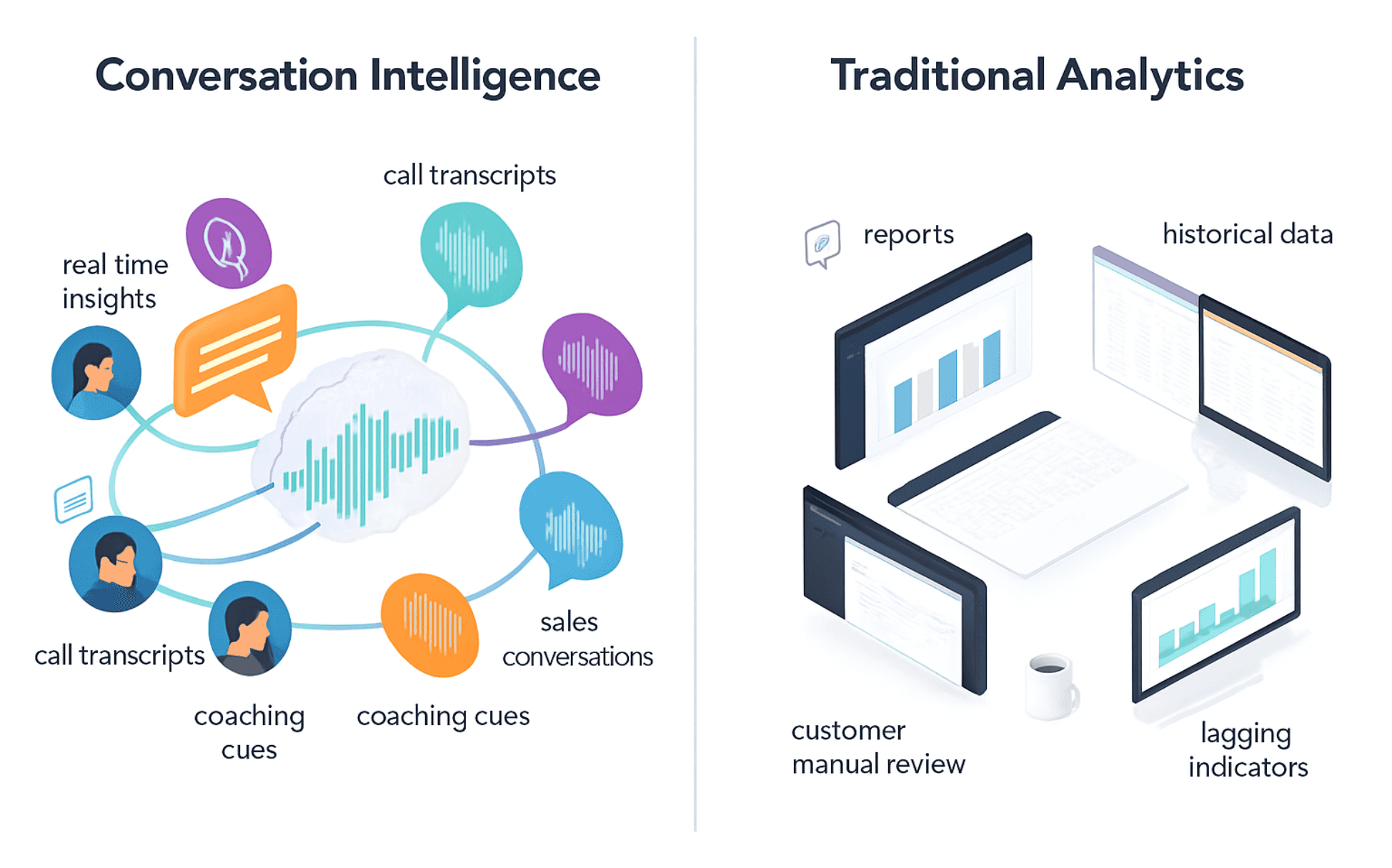
Conversation intelligence doesn't replace traditional methods, it fixes their fundamental limitations. Here's what changes when you move from analyzing 5% of customer feedback to 100%.
Survey-Based Analytics
Here's the problem with CSAT scores: They tell you the building is on fire, but not which floor.
Your CSAT drops from 4.2 to 3.8. Red alert. But is it a product bug? A policy change? A competitor undercutting you? The survey doesn't say. It just tells you customers are unhappy—thanks, super helpful.
Surveys suffer from three fundamental limitations:
Low response rates and selection bias. The 7-15% who respond aren't representative of your entire customer base. You're hearing from people who are either very happy or very angry, missing everyone in between.
Lagging indicators. Survey data tells you what customers thought weeks or months ago, not what's happening right now. By the time you spot a trend in quarterly NPS data, the damage is already done.
No context. Quantitative metrics like CSAT and NPS tell you customers are unhappy, but they can't explain why in rich detail. A score doesn't tell you the specific language customers use to describe problems, the emotional intensity behind frustration, the situational factors driving behavior, or the competitive comparisons they're making ("Your competitor does this better").
Here's a practical before-and-after: An insurance provider saw Customer Effort Score (CES) climb (higher scores = more effort = bad) and couldn't identify the cause. Quantitative metrics signaled an issue but gave no context.
They implemented sentiment analysis and discovered that 23% of calls included customers struggling with a new document upload feature that failed on Safari browsers. Quantitative metrics flagged the problem. Qualitative conversation analysis solved it.
The compounding effect grows with scale. When you analyze 100% of conversations, patterns emerge that no survey can capture:
You spot the mobile-only bug affecting 2% of users that accounts for 30% of negative reviews
You identify the specific phrasing one top agent uses that de-escalates 90% of angry calls
You discover the checkout step where 18% of enterprise customers abandon their upgrade
This is customer intelligence at scale—delivering the "why" behind the "what" and enabling targeted action instead of broad-brush initiatives.
Conversation intelligence complements surveys by providing the context and depth that quantitative scores can't capture. Surveys tell you what to measure. Conversations tell you what to fix.
Manual Quality Assurance
Here's the math problem destroying your QA program: It doesn't scale.
A typical contact center handling 5,000 calls per month, with 3% QA sampling reviews just 150 calls. If there's a mobile checkout bug that surfaces in only 2% of calls, but that issue causes 40% of all cart abandonment, it will likely slip through the cracks.
Traditional QA is time-consuming, subjective, and limited to tiny sample sizes (typically 1-5% of total interactions). This small coverage means you miss systemic issues and top-performer habits that could transform your entire team's performance.
The real cost? QA teams consume 10-15% of operational budgets while achieving only 70-80% scoring accuracy due to human bias. And because they can only sample a fraction of conversations, rare but high-impact issues go undetected.
Conversation intelligence analyzes all 5,000 calls, making it possible to catch those rare patterns that define customer outcomes. It provides:
100% coverage instead of 1-5% sampling
Consistent, objective scoring without human bias
Coaching opportunities at scale across your entire team
Real-time alerts for compliance risks and quality issues
While manual QA remains important for compliance spot-checks and complex training scenarios, conversational AI automates the heavy lifting. Your QA team can focus on strategic coaching and edge cases instead of spending hours listening to calls that meet standards.
Traditional Speech Analytics
Older speech analytics tools were a step forward, but they had a fatal flaw: they only understood keywords, not context.
They'd flag every time someone said "cancel" even if the customer was asking "Can I cancel just this one charge?" versus "I want to cancel my entire account." High false-positive rates. Missed nuance. Limited to voice calls only.
Modern conversation intelligence platforms represent a generational leap. They use transformer-based AI models and natural language processing to:
Understand context and intent, not just keywords
Analyze across every channel simultaneously - voice, chat, email, social, reviews
Detect sentiment nuances that keyword matching misses
Identify root causes through semantic understanding
The difference between "I love that you fixed this so fast" and "I love that it only took three calls to fix something that shouldn't have broken in the first place" is obvious to a human. Old speech analytics couldn't tell the difference. Modern conversation intelligence can.
This moves you from basic keyword counting to true qualitative analysis that delivers actionable insights and valuable intelligence for strategic decisions.
Don't Make This Mistake
The biggest implementation failure we see? Companies try to analyze everything, everywhere, all at once.
They want churn prediction, QA automation, agent coaching, product feedback intelligence, competitive intelligence, and upsell signal detection—all in month one.
It's too much. Teams get overwhelmed. Nothing sticks.
Pick ONE high-ROI use case. Prove the value in 60-90 days. Then expand. The companies that succeed with conversation intelligence are the ones that start focused and scale systematically.
How To Implement Conversation Intelligence Successfully
A successful implementation starts with a clear strategy and realistic expectations. Follow these steps to generate immediate value and build long-term ROI.
1. Define Clear Business Objectives
Start with the end in mind. What specific business outcome do you need to move on in the next quarter?
Reduce churn among enterprise customers by 15%?
Cut QA costs by 50% while improving coverage?
Increase upsell conversion from support-to-sales handoffs?
Improve first-call resolution rates by 20%?
Align your conversation intelligence goals with your core KPIs. Then pick ONE use case that will deliver the biggest impact. Avoid boiling the ocean.
Sales leaders might start with analyzing sales conversations to identify why deals are won or lost. CX leaders might focus on agent performance improvement. Support leaders might prioritize churn signal detection.
The key is proving ROI on a single, high-value use case before expanding. Companies that try to solve everything at once typically abandon the initiative within 6 months because they never achieve a clear win.
2. Audit Your Data Sources
Map every channel where customer conversations happen:
Contact center voice calls
Chat (website, in-app, SMS)
Email support
Social media mentions
Review sites
Sales call recordings
Assess the quality and accessibility of conversation data from each source. Document which channels capture what percentage of customer interaction volume.
Here's what most companies discover: 40% of their customer conversations happen in unstructured email threads or internal Slack messages that aren't captured in their contact center platform. These are blind spots you need to address.
Also map your conversation volume. If you're handling 2,000 calls per day (44,000+ monthly), comprehensive manual QA is economically impossible. You must choose between accepting dangerous blind spots or implementing AI-powered analysis.
3. Choose the Right Platform
Not all conversation intelligence platforms are created equal. Evaluate based on:
Channel coverage: Can it analyze voice, chat, email, and other text-based conversations from a unified platform? Or are you stuck with voice-only analysis?
AI sophistication: Does it use semantic understanding and context, or just keyword matching? Can it handle industry-specific terminology and your customer's language?
Integration capabilities: Does it connect seamlessly with your existing tech stack (Zendesk, Salesforce, Intercom, etc.)? The best platforms deliver data-driven insights where your teams already work.
Speed to value: Does it require 6-12 months of custom model training, or can you start getting insights within days?
Qualitative analysis depth: Does it provide surface-level categorization or true qualitative feedback analysis that reveals the "why" behind customer behavior?
If you need both CX intelligence and sales conversation analytics, ensure the platform can handle both use cases without requiring separate tools.
4. Start with a Focused Pilot
Launch a 30-60 day pilot with crystal-clear success metrics. For example:
If piloting churn reduction: Track at-risk customer identification accuracy and retention rates for pilot cohort vs. control group
If piloting QA automation: Measure time savings, coverage improvement, and coaching effectiveness
If piloting upsell intelligence: Track number of qualified leads generated and resulting conversion rates
Choose a manageable scope—one team, one channel, one clear objective—and prove the business case. This builds momentum and executive buy-in for broader rollout.
5. Establish Insight Workflows
Intelligence without action is just expensive data. Create clear processes for how insights flow to teams who can act on them:
Set up a weekly "conversation insights review" where Product, CX, and Support leaders review the top emerging themes and decide on next steps. Without this ritual, insights become shelf-ware—data that's never acted upon.
Automate insight routing. When the system detects a churn risk signal, it should automatically alert the customer success manager. When it spots an upsell opportunity, it should feed directly to the sales pipeline. When it identifies a product bug mentioned in 40+ conversations, it should create a ticket for engineering.
Define ownership. Who owns agent coaching decisions? Who prioritizes product improvements surfaced from feedback? Who manages retention outreach for at-risk customers? Clarify accountability up front.
6. Train Your Teams
Technology is only as good as the people using it.
For agents: Show them how conversation insights can improve their performance. Share specific examples of what top performers say differently. Make coaching sessions data-driven rather than subjective.
For leaders: Train them to interpret conversation intelligence data for strategic decision-making. What patterns indicate emerging issues? Which themes correlate with retention vs. churn? How do you prioritize fixes based on conversation volume and impact?
For sales teams: If you're analyzing sales calls, show reps how to review their own recordings to refine objection handling and closing techniques. Make it a tool for self-improvement, not a "gotcha" mechanism.
7. Scale and Expand
Once you've proven initial value, progressively add more channels and expand use cases across the organization.
Recommended expansion order:
Add remaining support channels (email, chat, social) to complete your support intelligence
Integrate sales call analysis for win/loss insights and sales coaching
Incorporate external sources (social media, review sites, community forums) for the complete voice of customer
Expand use cases from your initial focus (e.g., QA automation) to adjacent benefits (agent coaching, product feedback intelligence, churn prediction)
The companies that get the most value from conversation intelligence are the ones that start focused and scale systematically based on proven results.
In Summary
The era of making strategic decisions based on 5% of customer feedback is over.
The competitive advantage now belongs to organizations that harness the intelligence hidden in their daily customer conversations. Companies with complete conversation intelligence achieve 41% higher revenue growth than those operating with traditional survey-only approaches. They can predict and prevent issues faster, optimize operations better, and make smarter strategic decisions.
CX leaders who wait are actively choosing to ignore critical signals happening in thousands of daily conversations. While you wait for next quarter's survey results, competitors are identifying churn signals 45 days earlier, flagging upsell opportunities in real time, and fixing product issues before they spread.
The barrier to adoption has collapsed. What required 6-12 months of data science work three years ago now deploys in days. The question isn't "Is this technology mature enough?" anymore. The question is "Can we afford to delay while competitors build their intelligence advantage?"
Kapiche is the platform that CX and Support teams use to move from Voice of Customer 1.0 to VoC 2.0, from analyzing 5% of customer feedback through surveys to understanding 100% of customer conversations across every channel.
We pioneered the shift to comprehensive conversation intelligence with our AI-powered platform that turns unstructured conversations into structured, actionable intelligence. Our unique strength is unified, cross-channel qualitative analysis that helps you move from data to decisions faster than ever.
Stop making strategic decisions based on 5% of customer reality. See how Kapiche gives you complete visibility, watch an on-demand demo and discover what's hiding in your conversations right now.
FAQs
What is conversation intelligence?
Think of conversation intelligence as having an analyst who actually reads every single customer conversation and tells you what matters.
It's AI technology that automatically records, transcribes, and analyzes customer communications from all your channels—calls, chats, emails, social media, the works. But it goes way beyond transcription.
The platform uses natural language processing and machine learning to understand what customers actually mean, not just what they say. It spots patterns across thousands of conversations: "Hey, 23% of your customers are struggling with Safari browser issues," or "This specific phrase your top agent uses de-escalates 90% of angry calls."
You get the intelligence you need to drive revenue and reduce churn without hiring an army of analysts or drowning in data. It delivers insights about why customers reach out, how they feel, what's driving satisfaction or frustration, and where your biggest opportunities hide.
How does conversation intelligence work?
The process starts by integrating with your communication systems—your contact center platform, chat tool, email support, CRM, whatever you're using—to capture conversation data from every channel.
AI transforms voice, chat, and email interactions into text using advanced speech-to-text technology. From there, natural language processing analyzes customer conversations for key themes, intent, sentiment, and emerging patterns.
The system uses machine learning to continuously improve its understanding of your specific business context, customer language, and product terminology. It doesn't just count keywords—it understands context. "I love that you fixed this so fast," and "I love that it only took three calls to fix something that shouldn't have broken" are both technically positive language, but one is a satisfied customer, and the other is sarcasm-dripping frustration.
You receive insights through dashboards and automated reports that highlight customer needs, track performance trends, flag emerging issues, and identify coaching opportunities. The goal is to turn raw conversations into answers you can act on immediately.
What's the difference between conversation intelligence and speech analytics?
Traditional speech analytics is like a metal detector—it beeps when it finds the keyword you're looking for, but it can't tell you much about context.
It flags every time someone says "cancel" even if the customer is asking "Can I cancel just this one charge?" versus "I want to cancel my entire account." And it's typically limited to voice calls only.
Conversation intelligence is the next generation. It uses AI and natural language processing to analyze customer conversations across all channels—voice, chat, email, social, reviews—and actually understands context, intent, and nuance.
The difference is like going from a calculator to a financial analyst. One counts things. The other understands what the numbers mean and what you should do about it.
Modern conversation intelligence delivers data-driven insights into customer needs, team performance, emerging trends, and business impact. You move from surface-level keywords to a deeper understanding of your customers and how conversations drive outcomes.
What are the benefits of conversation intelligence for customer experience?
The benefits show up across every KPI you're measured on:
Improve customer satisfaction by understanding and fixing the root causes of friction instead of guessing. You finally know why that CSAT score dropped.
Reduce churn through early detection of at-risk customers. The system spots patterns of declining sentiment, repeat issues, and frustration 30-45 days before customers decide to leave—giving you time to intervene.
Increase customer lifetime value by automatically flagging upsell signals hiding in support conversations. When customers mention integration needs or describe use cases that match your premium tiers, you know immediately.
Improve agent performance with targeted coaching based on what actually works. You can identify the specific phrases your top performers use and scale those behaviors across your entire team.
Make faster, better decisions backed by comprehensive customer intelligence instead of anecdotal feedback from the 7-15% who bother responding to surveys.
The common thread? You finally understand what customers actually need and want, not what you assume or what a small sample tells you.
Can conversation intelligence integrate with existing CX tools?
Yes. Leading conversation intelligence platforms are designed to integrate seamlessly with your current CX tech stack.
Whether it's your CRM (Salesforce, HubSpot), help desk (Zendesk, Intercom, Freshdesk), contact center platform (Five9, Talkdesk, Genesys), or business intelligence tools (Tableau, Looker)—the best platforms connect with systems you already use.
These integrations make it easy to automate workflows and ensure conversation intelligence reaches the right teams and systems in real time. For example:
Churn risk signals automatically create tasks in your customer success platform
Upsell opportunities feed directly to your sales CRM
Product feedback mentions create tickets in Jira
Agent performance insights integrate with your workforce management system