Product
Solutions
Customers
Pricing
Resources
Product
Solutions
Customers
Pricing
Resources

Blogs

Blogs

Blogs

10 min read
10 min read

The 5 reasons why 95% of your customer conversations sit unanalyzed

The 5 reasons why 95% of your customer conversations sit unanalyzed

The 5 reasons why 95% of your customer conversations sit unanalyzed

Learn why 95% of customer conversations go unanalyzed, how survey data creates blind spots, and how AI unlocks complete, real-time CX intelligence today, faster

Learn why 95% of customer conversations go unanalyzed, how survey data creates blind spots, and how AI unlocks complete, real-time CX intelligence today, faster

customer-conversations-unanalyzed

TL:DR

TL:DR

TL:DR

CX leaders make high-stakes decisions using surveys that capture ~5% of customer reality. The other 95% rich, specific intelligence buried in calls, chats, and emails, goes unanalyzed, creating blind spots across CX, Product, and Support.

CX leaders make high-stakes decisions using surveys that capture ~5% of customer reality. The other 95% rich, specific intelligence buried in calls, chats, and emails, goes unanalyzed, creating blind spots across CX, Product, and Support.

Conversation data wasn’t usable at scale until now. AI can normalize every interaction into structured insight, revealing root causes, churn risk, and revenue signals in real time. This is VoC 2.0: full visibility, faster action, proven impact.

Conversation data wasn’t usable at scale until now. AI can normalize every interaction into structured insight, revealing root causes, churn risk, and revenue signals in real time. This is VoC 2.0: full visibility, faster action, proven impact.

Your CX team just presented to the board. The quarterly NPS dropped 8 points. The CEO wants to know why.

You pull up the survey data: 347 responses out of 6,800 customers. The open-ended comments mention "billing confusion" 23 times and "poor support experience" 31 times. That's all you have.

What you don't know: Your contact center handled 12,000 customer conversations that same quarter. Billing issues appeared in 2,400 of them, not the vague "billing confusion" from surveys, but specific friction points like "can't update payment method on mobile" and "charged twice for annual renewal." Support quality complaints weren't about agent rudeness; they were about agents lacking the authority to issue refunds, forcing customers to go through three escalations for simple requests.

The intelligence needed to fix your NPS problem exists. You're just operating with 95% blind spots.

This isn't just a survey problem - it's an organizational problem

Let's be specific about what's happening across your business right now:

In your support center, agents handle 2,000 calls per week. Your QA team manually reviews 20 of them, exactly 1%. Last month, a billing error affected 180 customers before anyone noticed. The pattern was visible in call transcripts from day three, but your 1% sampling missed it entirely. By the time escalations reached leadership, you'd already lost 12 customers and damaged relationships with 60 more.

In your product team, the roadmap debate centers on whether to invest in mobile app improvements or checkout flow optimization. The product has survey data showing 200 customers requested "better mobile experience." What they're missing: 8,000 chat conversations contain detailed mobile app friction, specific features that don't work, exact points where users abandon tasks, and clear comparisons to competitor apps. The decision gets made on instinct, and whoever speaks loudest, not based on comprehensive customer intelligence.

In your executive meetings, the CFO questions your $500K CX investment. You present before-and-after survey scores showing a 4-point improvement. They want to know what specifically drove the change and whether it's sustainable. You can't answer with confidence because you're measuring impact through 5% of customer reality. The conversation ends with "let's revisit this next quarter", code for "prove this actually matters."

This plays out thousands of times across organizations. Strategic decisions are made on incomplete data. Problems were discovered weeks after they started. Investments that can't be proven. All while the complete intelligence sits unanalyzed in customer conversations.

The hard truth about survey-based intelligence

Many of our customers report that email surveys now achieve response rates below 5%, with some as low as 1%. But the bigger issue is bias.

Survey respondents systematically differ from non-respondents. Dissatisfied customers are less likely to complete surveys, meaning your data captures only a fraction of customer reality and skews toward the satisfied minority. You're not getting representative intelligence; you're getting the people motivated enough to respond.

Meanwhile, conversation volume is exploding in the opposite direction. Support conversations contain 8-12 discrete pieces of business intelligence: reason for contact, satisfaction signals, product feedback, process friction, resolution outcome, emotional journey, agent effectiveness, and cross-sell opportunities.

The gap between what customers are telling you and what you're actually hearing has never been wider.

Why conversation data has been unusable (until now)

The problem isn't that organizations don't have conversation data. Most have years of it stored across contact centers, chat platforms, email systems, and CRM tools. The problem is that conversation data exists in forms that are inherently inaccessible for analysis.

Reason 1: The email problem

Take a typical email thread between a customer and support. Here's what the raw data looks like:
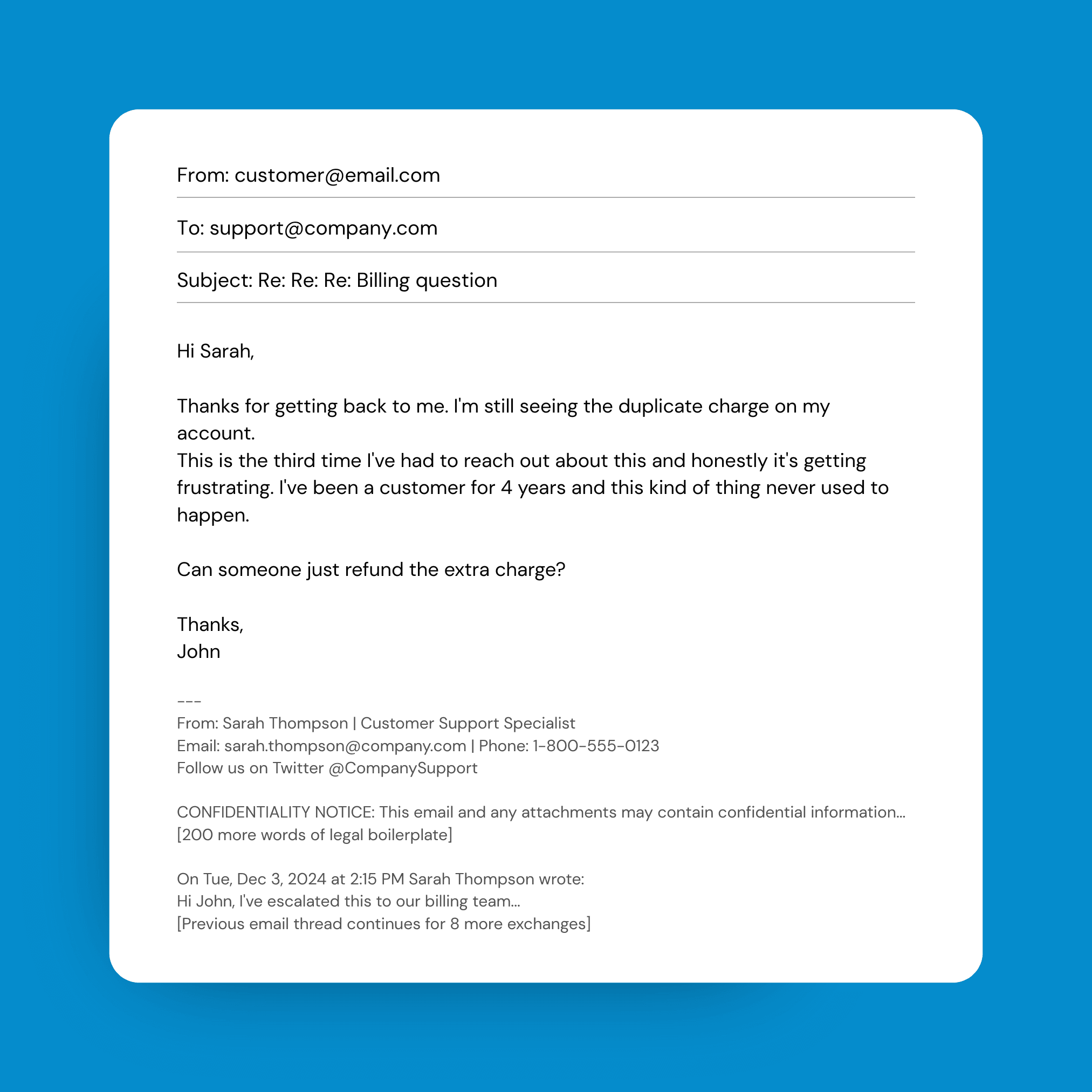
The actual customer message is 4 sentences buried in threading artifacts, signatures, legal disclaimers, and process history. Multiply this by 10,000 email threads per month and you have an impossible manual analysis task.

Reason 2: The chat transcript problem

Chat conversations present the opposite challenge, they're too long and meandering:
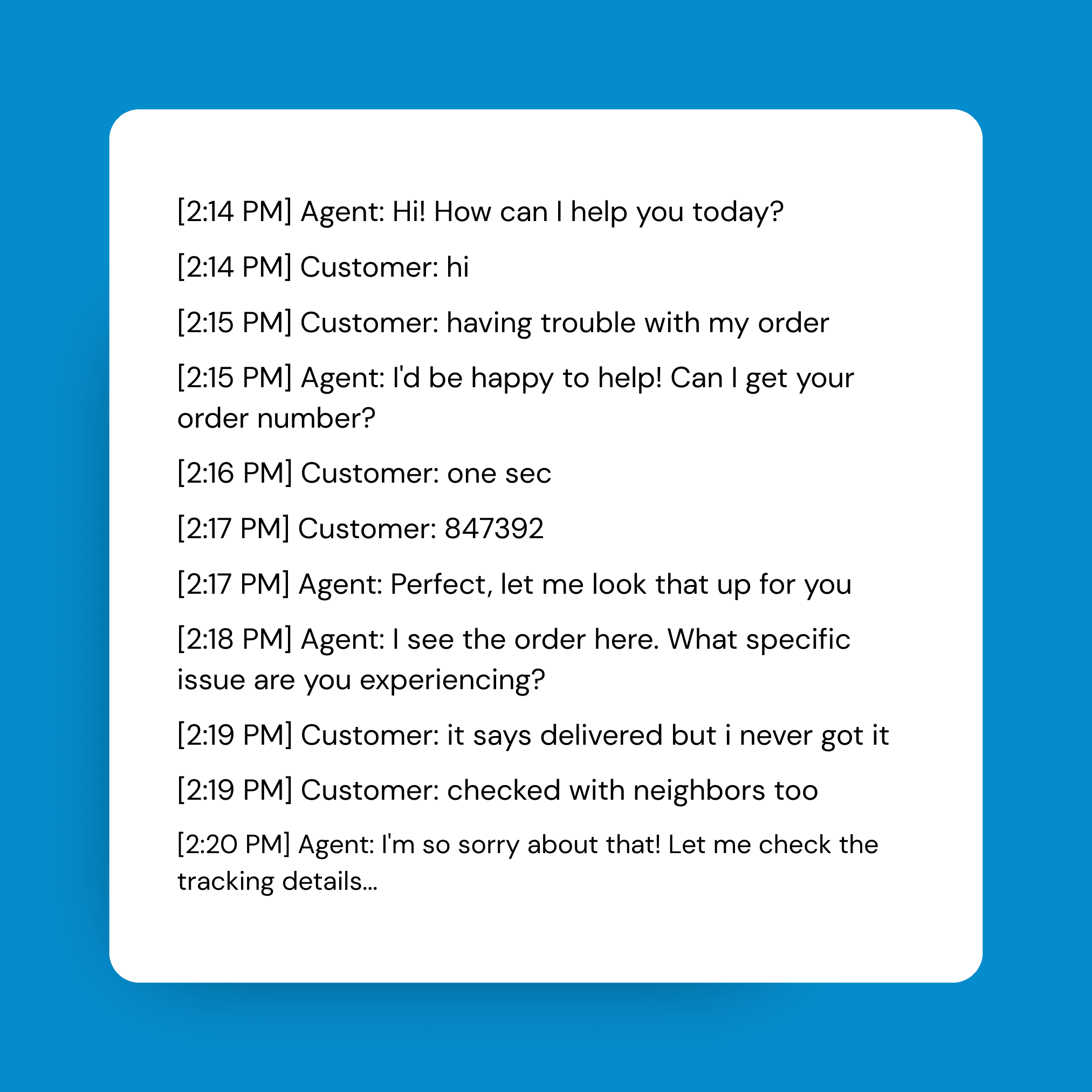
The actual issue, missing delivery, doesn't surface until the 10th message in a conversation that ultimately runs 40 exchanges. The critical business intelligence (delivery failure, carrier issue, customer frustration level, resolution outcome) is scattered throughout a 15-minute transcript filled with pleasantries and process steps.

Reason 3: The audio recording problem

Support calls are even more challenging. An 18-minute call might contain:

  • 2 minutes of hold music and IVR navigation

  • 3 minutes of verification and account lookup

  • 1 minute of small talk while the agent pulls up systems

  • 4 minutes of the customer explaining the issue (with tangents and background)

  • 5 minutes of troubleshooting and back-and-forth

  • 2 minutes of resolution and closing

  • 1 minute of post-call survey prompt

The actual reason for contact, satisfaction level, resolution status, and product feedback exist somewhere in those 18 minutes. But extracting it requires either:

  • Manual listening and note-taking (impossible at scale)

  • Expensive transcription with human review (too slow and costly)

  • AI transcription without structure (gives you searchable text but not analyzable intelligence)

Reason 4: The categorization nightmare

Organizations try to solve this with manual categorization. Agents tag tickets with reason codes, select disposition values, and mark resolution status. But this introduces three fatal flaws:

1. Human inconsistency: Agent A categorizes "customer can't find password reset email" as a technical issue. Agent B calls it a login problem. Agent C tags it as user error. Your trending data shows all three categories fluctuating, but you can't tell if the underlying problem is getting better or worse.

2. Training burden: New agents take 3-4 weeks to learn your categorization scheme. Until then, their data is unreliable. High agent turnover means you're constantly teaching categorization instead of focusing on customer outcomes.

3. Gaming the system: When agents know categorization affects their performance metrics, they optimize for the metrics rather than accuracy. "Issue resolved" gets selected even when the customer is clearly unsatisfied because it makes the agent's numbers look better.

Manual agent categorization typically achieves only 58-70% consistency across organizations. You're building a strategy on data that's wrong 30-42% of the time.

Reason 5: The cross-channel impossibility

Even if you could clean up individual channels, you face the final barrier: each channel uses completely different formats and schemas.

Your contact center measures "first call resolution" and categorizes calls by IVR tree selection. Your chat platform tracks "average response time" and tags conversations by product area. Your email system counts "replies to resolution" and has no categorization at all. Your survey platform measures NPS and asks different questions than your CSAT program.

When the VP of Customer Experience asks, "How is our checkout experience performing across all touchpoints?", there's no way to answer. The data exists in five different systems with five different measurement approaches and no common schema.

You can't compare satisfaction from calls versus chats because the methodology is different. You can't trend volume drivers over time because the categorization keeps changing. You can't connect product feedback to satisfaction impact because that data lives in separate systems.

This is the fundamental problem: Organizations generate millions of customer interactions containing the intelligence needed to drive retention, inform product decisions, and optimize operations. But conversation data exists in messy, unstructured, inconsistent formats that make systematic analysis impossible.

So they default back to surveys. Not because surveys are better, but because survey data is at least structured enough to analyze, even if it only represents 5% of reality.

The technology to fix this didn't exist until recently. Manual analysis doesn't scale. Traditional text analytics could find keywords, but couldn't extract structured intelligence. Rules-based categorization broke down under real-world complexity.

Generative AI changed what's possible.

The normalization layer that changes everything

AI Enrichments is Kapiche's intelligence engine that transforms messy customer conversations into consistent, structured data you can analyze, compare, and act on, regardless of channel, length, or format.

Here's what that actually means:

Every support call, chat, and email gets automatically enriched with structured information. Reason for contact. Estimated satisfaction score. Whether the issue was resolved. Product feedback is categorized as a bug report or a feature request. Agent performance is assessed with specific coaching recommendations.

The same methodology applies to every conversation, creating what didn't exist before: reliable customer intelligence with 100% coverage.

Now you can compare satisfaction from phone calls versus live chat with confidence in the methodology. Track volume drivers over time without relying on agent categorization. See product feedback from every channel in one consolidated view. Identify churn risk from conversation patterns before it shows up in surveys.

This is Voice of Customer 2.0. Complete conversation intelligence that makes surveys optional rather than required.

Who this is built for

If you're a Head of Customer Experience, you're tired of defending CX investments with survey data the board doesn't trust. You discover problems through quarterly reports instead of real-time signals. You can't answer "What's driving our satisfaction decline?" without weeks of manual analysis.

AI Enrichments gives you complete visibility across 100% of customer conversations with consistent measurement. You see what's driving satisfaction across the entire journey, predict churn before traditional metrics catch up, and prove CX ROI with concrete data connecting experience to business outcomes.

If you're a Head of Customer Support, your QA team can only review 1% of interactions manually. You're managing blind, unable to see systematic issues, agent performance gaps, or emerging problems until it's too late. When support volume spikes 30%, you know it happened but not why.

AI Enrichments expands QA coverage from 1% to 100% with objective performance data and specific coaching recommendations. You get diagnostic insights into what's really driving volume without relying on agent categorization. You spot emerging issues through real-time alerts instead of discovering them weeks later.

How it works in practice

Support volume diagnostics: A financial services company sees a call volume spike 30% over two weeks. Within hours, AI Enrichments reveals 60% of the spike relates to a mobile app update, specifically, customers struggling with a new login flow. Resolution rates for these calls are 40% lower than average. The product team rolls back the problematic feature within 48 hours. Volume returns to baseline within 3 days.

Agent performance at scale: A mid-market SaaS company operates 85 agents across three locations. Their QA team reviews about 1% of weekly interactions. AI Enrichments scores all 10,000 weekly calls, identifies 12 agents with consistently low resolution rates, and delivers specific coaching on conversation closure techniques. Within 6 weeks, the coached group's resolution rates improve 27%, and satisfaction scores increase 15 points.

Product intelligence from conversations: A B2B software company's product team manually reads transcripts, trying to understand customer needs. AI Enrichments automatically surfaces that advanced filtering appears in 847 conversations over 90 days, and customers who mention this missing feature have 12-point lower satisfaction scores. The product team prioritizes the feature based on comprehensive data showing both volume and business impact.

Predictive churn prevention: An enterprise subscription business discovers customers are at-risk only when they don't renew. AI Enrichments identifies conversation patterns that predict churn risk—declining satisfaction trends over multiple interactions, unresolved issues, and negative emotional patterns. Customer success receives automated alerts for at-risk customers based on actual conversation signals, not surveys that may never come. Retention rate for engaged at-risk customers improves from 45% to 73%.

The competitive gap is widening

Organizations using complete conversation intelligence make data-proven decisions, while others rely on partial survey insights and intuition.

They see problems earlier through real-time conversation signals versus quarterly surveys. They act faster with structured data ready for analysis versus manual transcript review. They prove impact better with consistent measurement across channels versus fragmented data.

This advantage compounds daily.

With 80% of organizations predicting real-time conversation intelligence as 2025's most transformative capability, the question isn't whether to move from surveys to conversations. It's whether you'll build this advantage now or keep making strategic decisions with 95% blind spots while your competitors pull ahead.

See what you're missing

Complete customer intelligence isn't just better decision-making. It's a fundamentally different way to run your business, with complete information instead of partial samples, proactive intervention instead of reactive response, proven impact instead of gut feel.

Your customers are already telling you everything you need to know across every interaction. The only question is whether you're ready to listen to all of them.

See what AI Enrichments uncovers in your customer conversations →

AUTHOR

AUTHOR

Ryan Stuart
Ryan Stuart

Ryan Stuart

Ryan Stuart

CEO & Co-Founder

CEO & Co-Founder

Enjoying this article?

Share it with the world!

Enjoying this article?

Share it with the world!

Make smarter
business choices

Make smarter
business choices

Insights That Power Smarter Decisions

Get monthly VoC insights and resources
to elevate customer experiences

Enter your work email

Subscribe

Insights That Power Smarter Decisions

Get monthly VoC insights and resources
to elevate customer experiences

Enter your work email

Subscribe

Insights That Power Smarter Decisions Get monthly VoC insights and resources
to elevate customer experiences

Enter your work email

Subscribe

How Teams win with Kapiche

How Teams win with Kapiche

How Teams win with Kapiche

Explore how businesses like yours are cutting costs, boosting satisfaction,

See every customer signal
across every customer conversation

Get a personalized demo of how conversation intelligence transforms your CX and support operations.

See every customer signal
across every customer conversation

Get a personalized demo of how conversation intelligence transforms your CX and support operations

See every customer signal
across every customer conversation

Get a personalized demo of how conversation intelligence transforms your CX and support operations

The conversation intelligence platform that analyzes every customer interaction to predict churn, improve operations, and prove ROI.

The conversation intelligence platform that analyzes every customer interaction to predict churn, improve operations, and prove ROI.

Subscribe to our newsletter

Enter your email address

Subscribe to our newsletter

Enter your email address

Subscribe

Copyright © 2025 Kapiche | All Rights Reserved | Terms and Conditions | Privacy Policy

Copyright © 2025 Kapiche | All Rights Reserved | Terms and Conditions | Privacy Policy